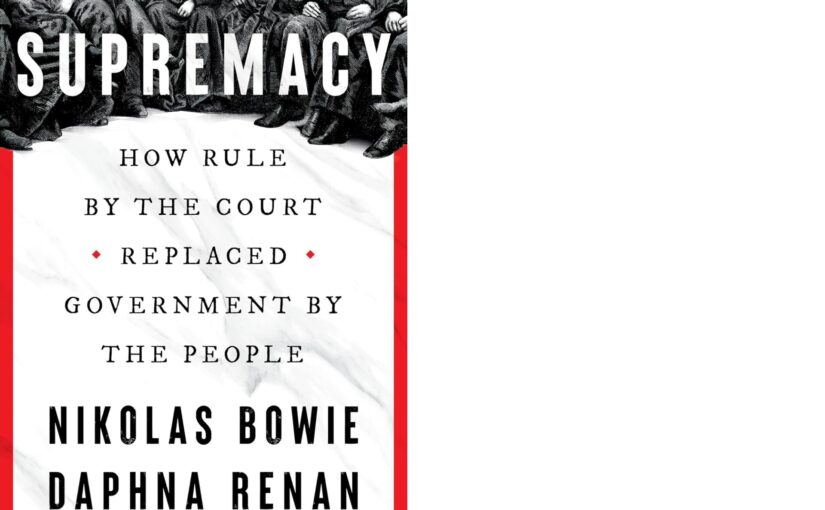
How Rule by the Court Replaced Government by the People
by Nikolas Bowie (Author, Harvard Law School), Daphna Renan (Author, Harvard Law School)
Recommended by Bruce R.
From two acclaimed legal scholars, a new history of the Supreme Court that overturns our most basic assumptions about its role in our democracy, showing how it seized the power it now wields.
Does the U.S. Constitution force us to live under the rule of nine robed lawyers? Many Americans assume that it does. It is commonly said that the Supreme Court has always had the power to decide what the Constitution means and to strike down any act of Congress that violates the justices’ dictates. Even as the Court has used this power to upend democracy—erasing federal laws that once prevented presidential autocracy and protected the right to vote—we are told there is nothing everyday Americans can do, as if our ability to govern ourselves requires the Court to answer our most fundamental questions for us.
But what if that isn’t accurate? What if the Court was not given the power it now wields, but rather seized it?
That is the revelation of Nikolas Bowie and Daphna Renan’s masterful new account of the Supreme Court. In a sweeping narrative of over 200 years of American history, they demonstrate that “judicial supremacy” was not written into the Constitution and has always been challenged as fundamentally at odds with it. Far from being an eternal principle, the power the Court claims to override Congress’s interpretation of the Constitution took hold in reaction to abolition and Reconstruction—not to protect democracy, but to weaken it.
Supremacy charts how the Court has repeatedly sabotaged the efforts of Congress to broaden democracy by enabling presidents, corporations, and the wealthy to ignore enacted law. It also challenges how even liberals understand the Court’s most celebrated rulings—including Brown v. Board of Education and Roe v. Wade—showing how the left has unwittingly subscribed to the very ideology that now threatens it.
At every step, Bowie and Renan recover a lost constitutional tradition, one forged by abolitionists, labor leaders, suffragists, and civil rights pioneers. These individuals presented another way forward, in which power is returned to where the Constitution put it—Congress—and everyday Americans have more of a say in the law that shapes our lives.